
Rooted & Radiant: Beet Medicine for Blood, Liver & Summer Balance

Updated: Aug 8
A few nights before I harvested the first beets from my garden, I dreamed of them.
I could see their deep red roots in my mind—rich, earthy, and almost glowing beneath the soil. I didn’t know exactly why, but something about them was calling to me. Even before they were ready to harvest, I found myself falling in love with them, admiring their vibrant greens with a sense that whatever was growing beneath the surface was going to be something special.
By the end of the week, the beets were ready.
And I started menstruating—on the full moon.

A Different Kind of Cycle
I was on the third day of my cycle when I first began writing this story, and something felt noticeably different.
Usually, the first few days were rough. My flow tended to be heavy—like, really heavy—and I often experienced cramps, pain, fatigue, brain fog, and irritability. Emotionally, I sometimes felt as though I simply wanted to hide from the world for a few days.
But that cycle was different.
My flow felt more moderate. I wasn’t experiencing the pain I usually expected, my mood remained surprisingly balanced—no angry outbursts, IYKYK—and I had more energy and clarity than usual. I also noticed that I didn’t appear quite as pale.
I had been eating beets and beet greens from the garden throughout the week, and I couldn’t help wondering whether that steady nourishment had helped support my system through my cycle.
That doesn’t mean beets alone changed everything, and one experience cannot tell us precisely what caused a shift in the body. But the timing made me pay attention. My body had been drawn toward this particular food before I consciously understood why.

The Ayurvedic Wisdom of Beets
In Ayurveda, beets are primarily sweet, earthy, substantial, and heating. Their grounding root energy can be especially supportive for Vata, helping nourish the body when we feel depleted, scattered, dry, or unsteady.
This grounding quality can be particularly welcome during menstruation. The downward movement of the cycle is governed by apana vayu, a subtype of Vata responsible for elimination, menstruation, and other downward-moving functions. Warm, cooked, well-seasoned root vegetables can offer steadiness during a time when the body is already releasing and energy may feel more vulnerable.
Beets are also traditionally associated with nourishment of rasa dhatu, the plasma and lymph tissue, and rakta dhatu, the blood tissue. Their deep ruby color, natural sweetness, and substantial nature have long connected them with blood nourishment, circulation, and vitality in Ayurvedic food wisdom.
However, grounding does not necessarily mean cooling.
Beets are considered heating and may increase Pitta when eaten frequently, in large portions, or alongside other strongly heating foods. During summer, I balance them with cooling and gently cleansing ingredients such as fennel, cilantro, mint, cucumber, pomegranate, coconut, tahini, or lime. Cooking them with coriander or fennel can also soften their heat while supporting digestion.
This is one of the beautiful nuances of Ayurveda: a food does not have to be categorically “good” or “bad” for a dosha. Season, preparation, portion, digestive strength, and the needs of the individual all influence how that food meets the body.
Beets, the Liver, and Summer Heat
The liver is one of the primary sites of Pitta in the body. It plays an essential role in transformation, metabolism, and processing what enters our systems.
When summer heat combines with stress, overwork, hormonal changes, irregular meals, or insufficient rest, Pitta can begin to feel excessive. We may notice more irritability, skin sensitivity, headaches, digestive heat, or a general feeling of being internally overcooked.
Beets are often included in seasonal meals intended to support the liver, circulation, and healthy elimination. But because the root itself is warming, balance matters. A small serving of beets in a bowl filled with cooling herbs, greens, cucumber, fennel, and a creamy tahini dressing feels very different from a large plate of heavily spiced roasted beets on an already sweltering day.
Ayurveda continually brings us back to relationship. We are not simply asking, “Are beets good for Pitta?” We are asking, “How are these beets prepared, what season are we in, and what is this particular body asking for today?”
Western Nutrition: More Than Iron
Beets are often described as an iron-rich food, but the roots actually provide only a modest amount of iron and vitamin C. Their greater nutritional gifts include folate, fiber, potassium, manganese, naturally occurring nitrates, and colorful plant pigments called betalains.
Folate supports normal cell division and red blood cell formation, while dietary nitrates can be converted by the body into nitric oxide, supporting healthy blood flow and circulation. Betalains contribute the deep red and golden pigments we associate with beets and provide antioxidant activity.
Beets can certainly be part of a nourishing pattern for someone supporting blood health, but they are not a replacement for iron-rich foods or appropriate care for anemia.
I love pairing them with lentils, chickpeas, tahini, pumpkin seeds, eggs, meat, or other substantial foods, along with vitamin C–containing vegetables and herbs.
And then there are the beet greens.
The leaves and stems are not scraps attached to the “real” vegetable. They are an incredibly valuable part of the harvest, offering their own fiber, minerals, antioxidants, bitterness, and nourishment.

Three Vegetables in One
The more I grow and cook beets, the more I think of them as nearly three vegetables disguised as one:
The root is sweet, dense, earthy, and grounding.
The stems are colorful, gently crisp, and slightly sweet.
The leaves are tender, mineral-rich, and pleasantly bitter.
The leaves and stems can be prepared much like Swiss chard—which is no coincidence. Beets and chard are different cultivated forms of the same plant species, Beta vulgaris. Chard was developed for its abundant leaves and stems, while beets were developed for their swollen roots.
So chard gives us two vegetables in one, but apparently its beet cousin had to show off and give us three. 😆
When the stems are thick, I chop them separately and begin cooking them a few minutes before adding the leaves. Tender stems can be sautéed right alongside the greens. The entire plant can go into soups, egg dishes, grain bowls, vegetable sautés, and brothy meals.
Nothing about this beautiful plant needs to be treated as scraps.
How I Ate Them This Week
Roasted in ghee with garlic scape powder and a splash of red wine vinegar
Thinly sliced raw in salads with tahini, fennel, and fresh greens
Sautéed with their own stems and leaves
Seasoned with green onion powder, salt, and digestive spices
Added to bowls with grains, beans, herbs, and vegetables
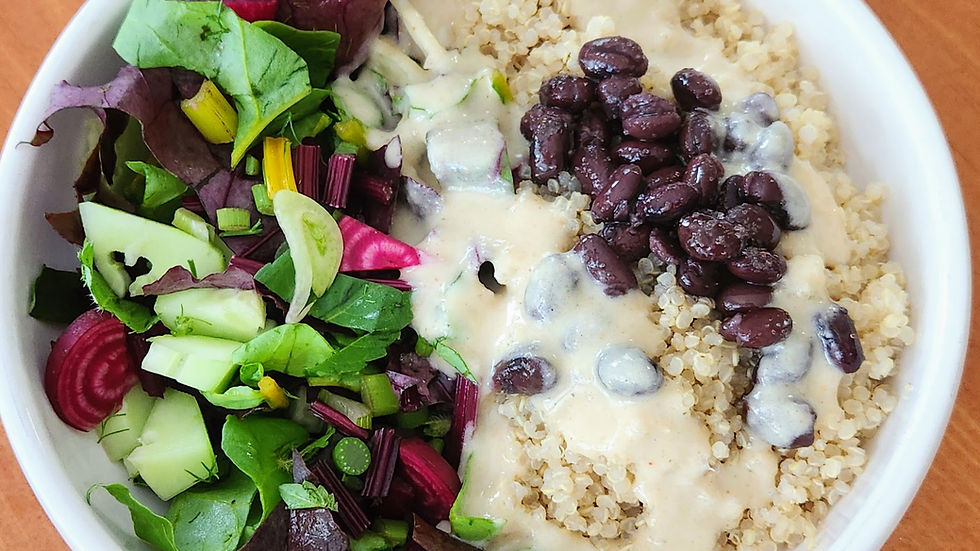
One of my favorite combinations became a Beet, Chard & Fennel Buddha Bowl with Creamy Tahini Dressing. The fennel, cucumber, greens, and tahini bring cooling, light, and creamy qualities that balance the earthy warmth of the beets.
I didn’t try to make them complicated. I let the garden lead and allowed the ingredients to become the meal.

This Is What It Means to Live in Tune
I didn’t plan that experience.
I didn’t sit down and decide, “I need more iron, so I’ll eat beets this week.” It unfolded the way nature often does—through a craving, a dream, a harvest, and a moment of paying attention.
Ayurveda teaches us to listen to the body’s whispers before they become screams. That does not mean every craving is a diagnosis or that one food is a cure. It means we cultivate enough awareness to notice patterns, remain curious, and recognize when the body may be asking for nourishment, rest, warmth, cooling, grounding, or support.
That week, my body seemed to be asking for beets.
My garden provided them.
And my cycle gave me a reason to listen more closely.
A Note From My Kitchen, One Year Later
A year after first writing this story, my relationship with beets has only grown.
This season, I find myself with an abundance of baby beets to cook, store, pickle, freeze, and preserve for winter. I’m blanching the leaves, saving the stems, roasting the roots, and continuing to discover just how generous one plant can be.
What began as a story about menstruation, blood nourishment, and a timely garden harvest has become part of a much larger practice: learning to use the whole food, preserve the season, and waste as little as possible.
You can explore the updated Living Food Guide entry for beets for their Ayurvedic qualities, preparation, storage, preservation, and plenty of ideas for using an abundant harvest.
An Invitation to Listen
Perhaps this is your reminder to become curious about the foods calling to you.
Notice what is growing around you. Notice what catches your eye at the farm, farmers market, or in your own garden. Notice how different preparations feel in your body and how your needs change with the seasons.
Food is not separate from our lives. It carries the soil, the weather, the hands that tended it, the season in which it grew, and the care we bring to preparing it.
Sometimes healing arrives through a major change.
And sometimes it looks like a root vegetable appearing in a dream, waiting patiently beneath the soil, ready to nourish us when we finally pull it from the earth.
Thank you for letting me share this piece of my journey.
With love and beet-stained hands,
Jennifer
This article shares personal experience and general Ayurvedic education. It is not intended to diagnose or treat anemia, menstrual disorders, heavy bleeding, or any other medical condition. Persistent heavy bleeding, fatigue, dizziness, shortness of breath, or suspected anemia deserves appropriate medical evaluation.


Thank you for this post! I’m curious as to whether you eat the tops as well.